He went back home bare-footed…

Source text:

ﺧﺮﺝ ﺟﺤﺎ ﻣﻦ ﺍﻟﻤﺴﺠﺪ ﻓﻠﻢ ﻳﺠﺪ ﺣﺬﺍﺀﻩ !..  0-0 –
ﻓﻮﻗﻒ ﻳﺼﺮﺥ ﺍﻣﺎﻡ ﺍﻟﻨﺎﺱ ﺑﺼﻮﺕ ﺗﻬﺪﻳﺪ .. “ﺍﻗﺴﻢ ﺑﺎﻟﻠﻪ ﺍﻥ ﻟﻢ ﺗﺤﻀﺮﻭﺍ ﻟﻲ ﺣﺬﺍﺋﻲ .. ﺳﻮﻑ ﺍﻓﻌﻞ ﻛﻤﺎ ﻓﻌﻞ ﺍﺑﻲ” .. !!  0-0 –
ﻓﺘﺠﻤﻊ ﺍﻟﻨﺎﺱ ﺣﻮﻟﻪ ﻣﻨﺪﻫﺸﻴﻦ ﻭﺳﺎﻟﻮﻩ !.. ﻭﻣﺎﺫﺍ ﻓﻌﻞ ﺍﺑﻮﻙ؟!  0-0 –
ﻓﻘﺎﻝ ﻣﻬﺪﺩﺍ : “ﺍﺣﻀﺮﻭﺍ ﻟﻲ ﺣﺬﺍﺋﻲ .. ﻭﺍﻻ ﺳﻮﻑ ﺍﻓﻌﻞ ﻛﻤﺎ ﻓﻌﻞ ﺍﺑﻲ” ..  0-0 –
ﻓﺨﺎﻑ ﺍﻟﻨﺎﺱ ﻣﻨﻪ ﻭﺍﺣﻀﺮﻭﺍ ﻟﻪ ﺣﺬﺍﺀ ﺟﺪﻳﺪ ﺛﻢ ﺳﺎﻟﻮﻩ !..  0-0 –
ﻗﻞ ﻟﻨﺎ ﻳﺎﺟﺤﺎ ﻣﺎﺫﺍ ﻓﻌﻞ ﺍﺑﻮﻙ؟!  0-0 –
قال :  0-0 –
..
..
عَادَ إلى بيْتِهِ حَافِيَاً !!!  0-0 –

Translation:

One day, Juha came out from the mosque and discovered that his shoes were missing. So he began shouting to other people with a threatening voice: “I swear by God, if you don’t give me back my shoes, I will do exactly like what my father used to do when his shoes were stolen!”

Astonished by the scene, people began gathering around Juha and asked  him: “What did your father used to do?”

Then Juha repeated his  threat: “I swear by God, if you don’t give me back my shoes, I will do exactly like what my father did when his shoes were stolen!”

Upon that, the people began fearing him and decided to give him a new pair of shoes as replacement for the lost one.

After that, they asked Juha out of curiosity: “Can you please tell us what your father actually did when his shoes were stolen?”

Juha answered: “He went back home bare-footed.”

_____

Translated by Syawal
News from Egyptian Muslim Brotherhood’s website

A short paragraph I chose from a news piece published at Muslim Brotherhood’s website.

Source text:

اقتحم مجهولون مقر طلاب جماعة الإخوان المسلمين بجامعة الإسكندرية بمنطقة سموحة مساء أمس وقاموا بسرقة جهاز الحاسب الآلي الرئيسي بالمقر، واستولوا على ما فيه من ملفات وأوراق

Translation:

A group of unknown intruders stormed into the office of students affiliated with the Muslim Brotherhood (1) movement at University of Alexandria in the neighborhood of Semoha yesterday evening. They stole the main computer and took hold of the files and documents from the office.

_____

Translated by Pak Ngah

******************************

Notes

  1. While “Muslim Brotherhood” is the most widely used translation of al-ikhwaaan ul-muslimoon, and also the one used by the organization to describe themselves, “Society of Muslim Brothers” <– used by Richard Mitchell since 1969, seems to be the better translation.

There was a man who…

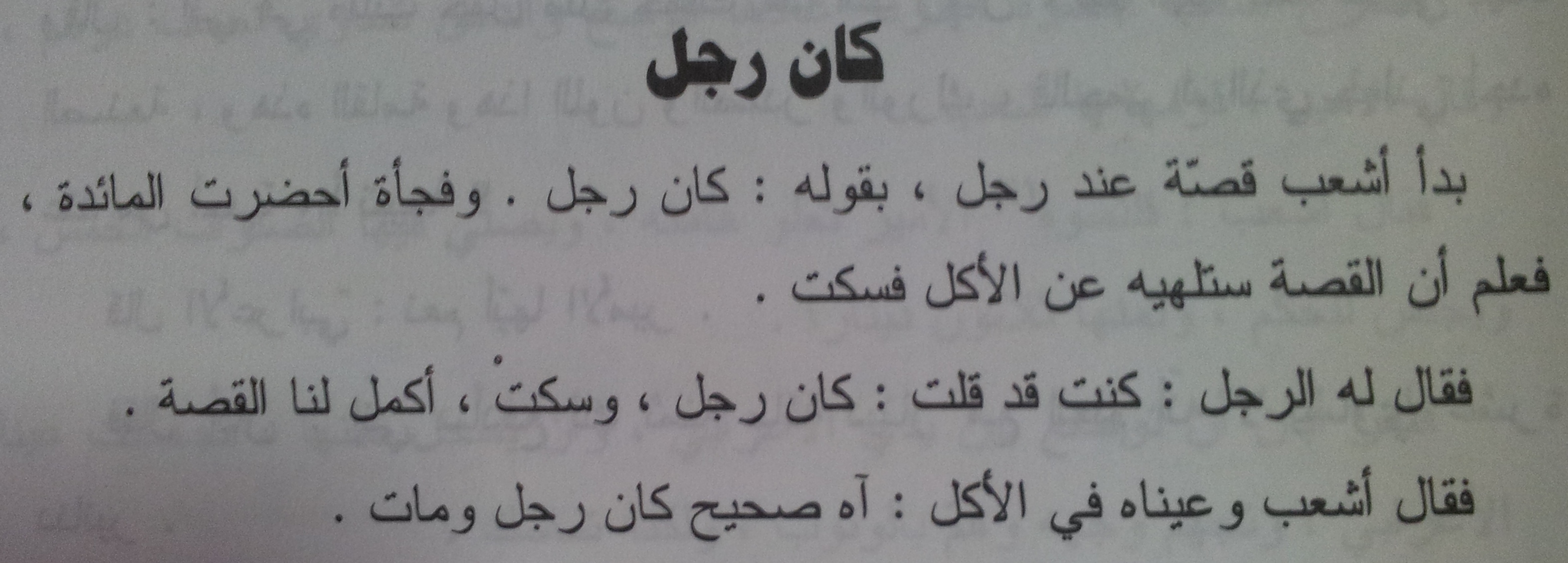
Source text:

There used to be a man...

Translation:

There was a man who…

Ash’ab was about to to tell a story about a man. He began by saying: “There was a man who…”

Suddenly, Ash’ab was interrupted by food arriving to be served. He knew that the story he was about to tell would distract him from eating. Therefore, he went silent.

Then, the man with Ash’ab asked him: “I heard you said ‘there was a man who…’, and then all of a sudden, you fell silent. Do you mind completing the story you wanted to tell us?”

While having his eyes focused on the food, Ash’ab said: ” Aah.. yes… that’s right… there was a man who… then he died…”

_____

Translated by Syawal


Juha and knowledge about social customs…

Source text:

Tiga ciri2 - P1


Tiga ciri2 - P2

Translation:

Three characteristics of people that you should know

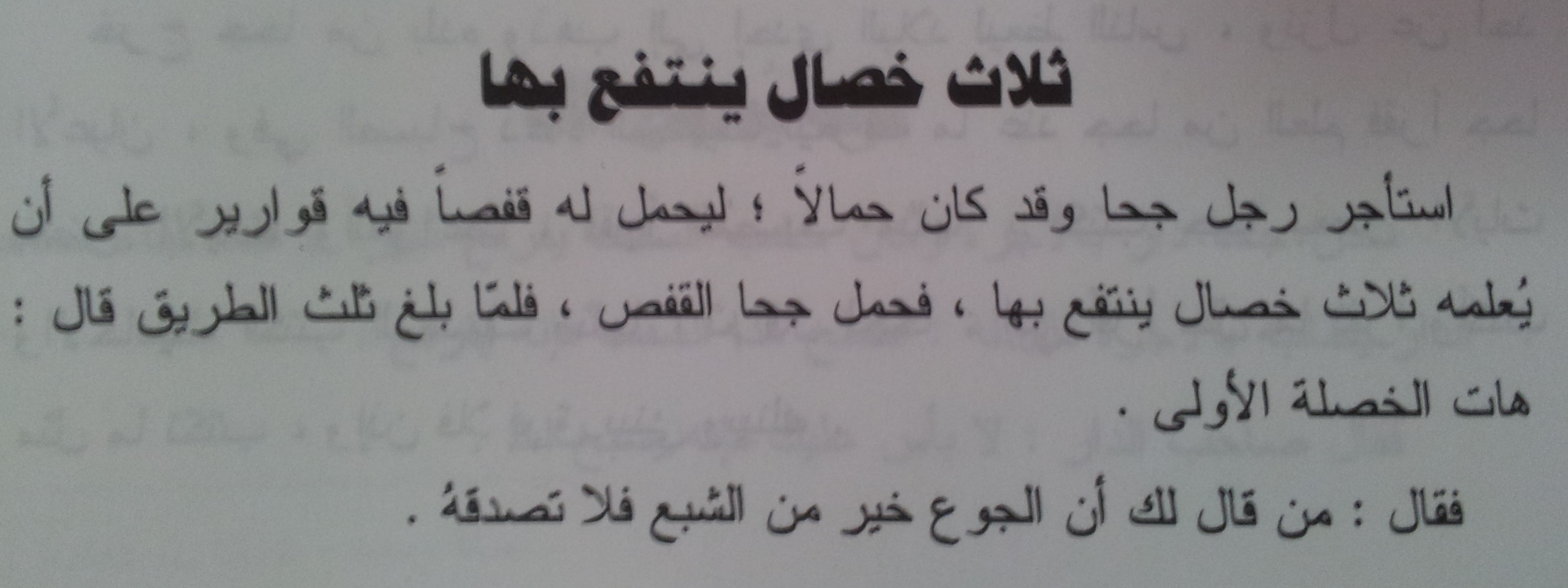
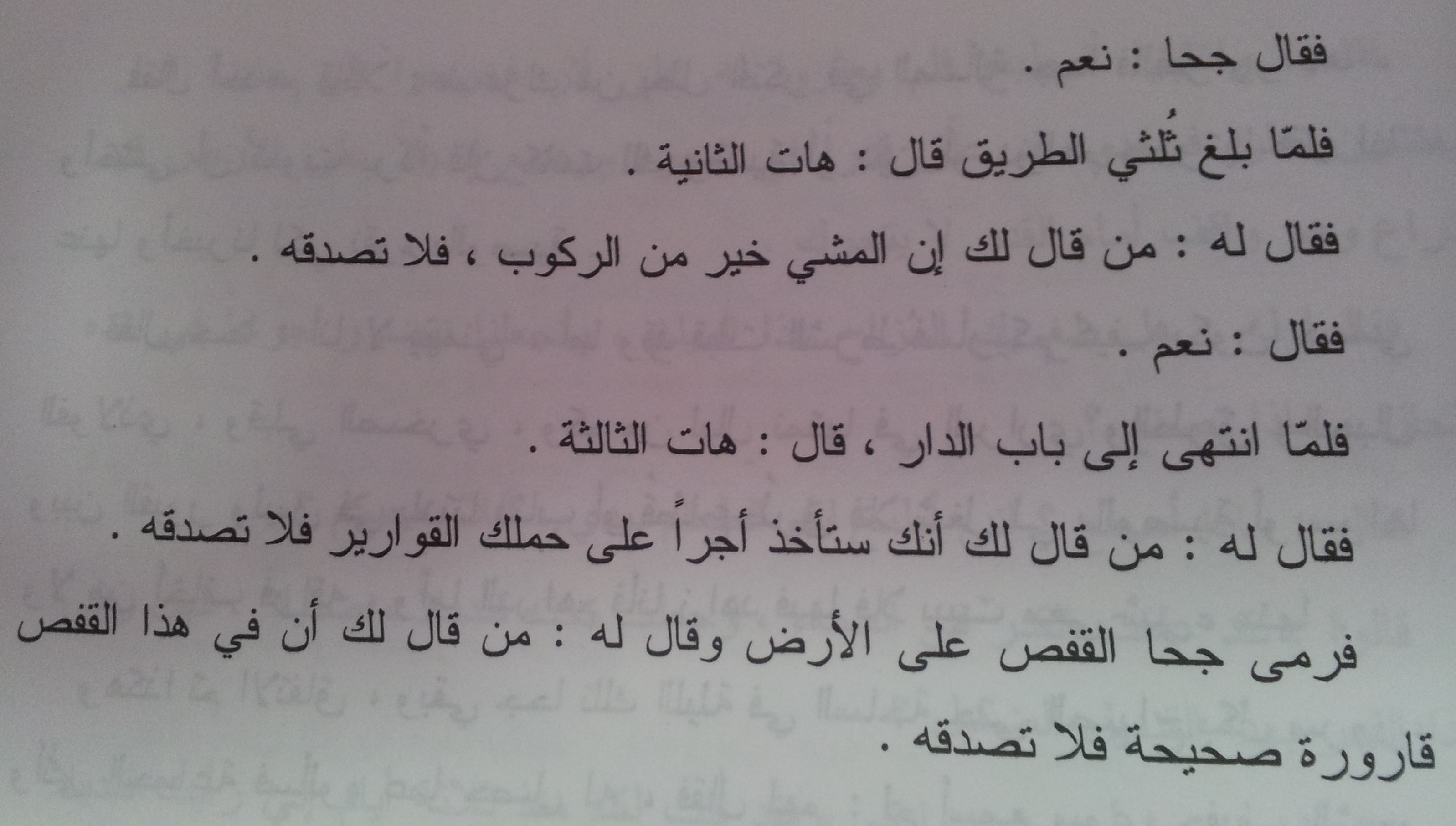
A man wants to hire Juha to carry a basket containing glass bottles to his house. In return for transporting the basket, the man will teach Juha three points of wisdom about people’s attitude in dealing with others, that he could benefit from, as a form of payment. Juha agreed to this proposal and began carrying the basket towards the destination. Once he completed a third of the distance, Juha stopped and asked the man: “Tell me the first point!”

The man said: “Whoever told you that hunger is better than filled stomach, do not believe him!”

Juha said: “Of course.”

When Juha reached two-third of the distance, he said: “Tell me the second point!”

The man said: “Whoever told you that walking is better than riding, do not believe him!”

Juha said: “Of course.”

When Juha finally reached the destination, he said: “Tell me the third point!”

The man said: “Whoever told you that you will receive a worthy payment in return for carrying these glass bottles, do not believe him!”

Feeling cheated, Juha flung the basket on the ground and said: “Whoever told you that the basket contains unbroken glass bottles, do not believe him!”

_____

Translated by Wai

Ibn ul-Jassas blundered… one after another…

Source text:

mixed up

Translation:

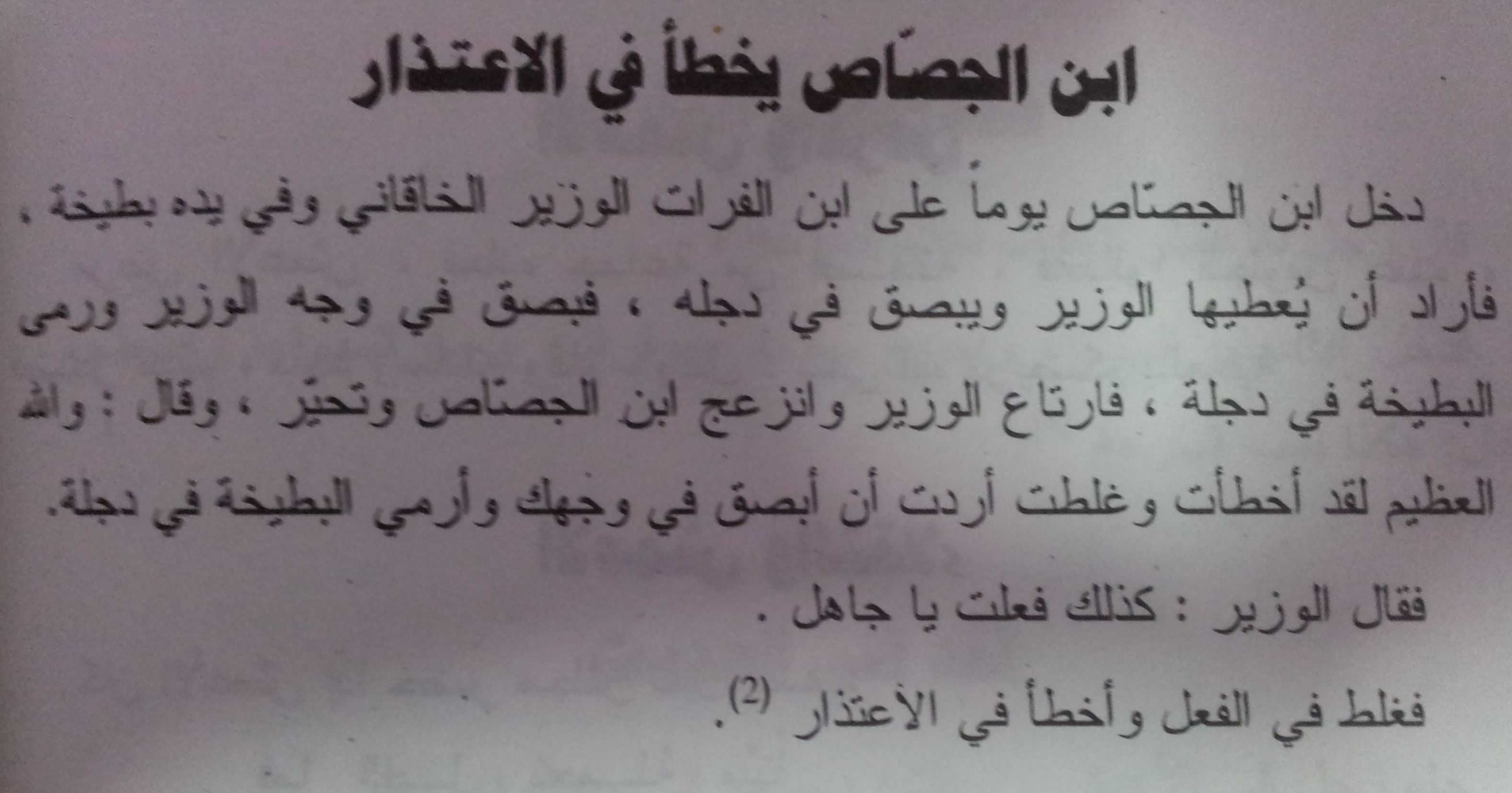
Ibn ul-Jassas messed up in his apology

Ibn ul-Jassas met ibn ul-Furat, the Khaganate minister, while holding a watermelon. He intended to give the watermelon to the minister and to spit into the Tigris (1). Instead, he spit onto the face of the minister and threw the watermelon into the Tigris. The minister was shocked and ibn ul-Jassas became worried and confused with what he just did. So, ibn ul-Jassas apologized by explaining: “I swear by God that I mixed up my actions and I made a big mistake! What I actually wanted to do was to spit onto your face and to throw the watermelon into the Tigris!”

The minister responded: “That was exactly what you did, idiot!”

Certainly, ibn ul-Jassas mixed up in his actions and messed up in his apology.

_____

Translated by Syawal

******************************

Notes:

  1.  Tigris River and the Euphrates are the two rivers that make up the Mesopotamia in present day Iraq.

Susu warna merah

Lagi satu terjemahan dalam bahasa Melayu. Orait?

Source text:

Susu merah

Translation:

Susu Berwarna Merah

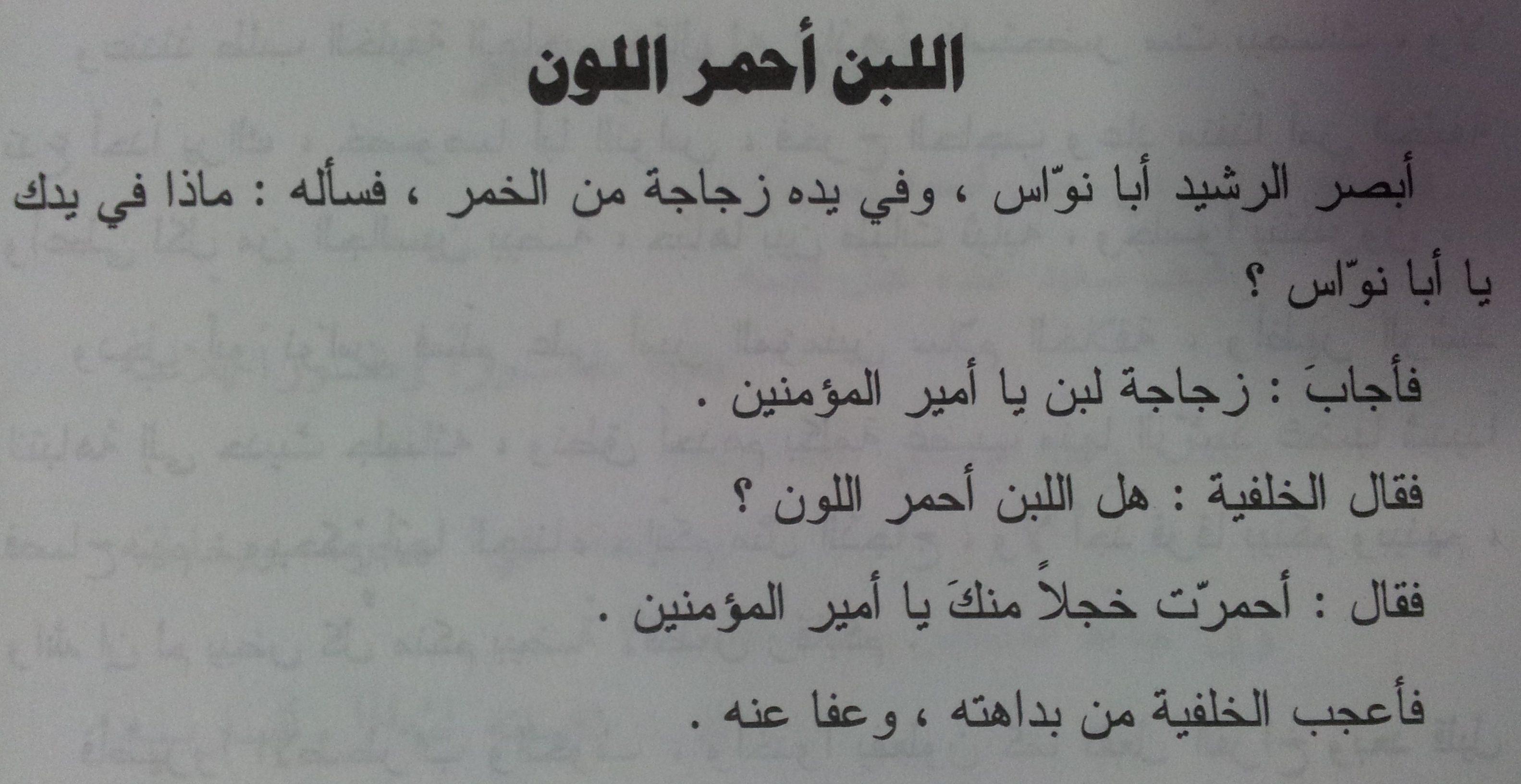
Pada suatu hari, khalifah Harun al-Rashid terserempak dengan Abu Nuwwas. Pada ketika itu Abu Nuwwas sedang memegang botol arak (1) di dalam tangannya. Maka, Harun  al-Rashid pun bertanya kepada Abu Nuwwas: “Apa di dalam tanganmu itu wahai Abu Nuwwas?”

Abu Nuwwas menjawab: “Sebotol susu wahai Amir ul-Mukminin.”

Harun al-Rashid bertanya lagi: “Ada ke susu warna merah?”

Abu Nuwwas menjawab: “Susu ni jadi merah sebab malu dengan engkau wahai Amir ul-Mukminin.”

Khalifah Harun al-Rashid terpesona mendengar betapa spontan-nya jawapan yang diberi oleh Abu Nuwwas. Oleh itu, beliau pun tidak menjatuhkan hukuman ke atas Abu Nuwwas.

_____

Translated by Abu Abdullah

******************************

Notes:

  1. Red wine agaknya

Please don’t tell anyone that I saved you…

Source text:

كان الحجاج بن يوسف الثقفي يستحم بالخليج فأشرف على الغرق فأنقذه أحد المسلمين
و عندما حمله إلى البر قال له الحجاج : أطلب ما تشاء فطلبك مجاب
فقال الرجل : ومن أنت حتى تجيب لي أي طلب ؟
قال: أنا الحجاج الثقفي
قال له : طلبي الوحيد أنني سألتك بالله أن لا تخبر أحداً أنني أنقذتك

Translation:

Al-Hajjaj bin Yusof al-Thaqafi once took a bath at the bay and nearly drowned himself. A muslim passerby saw Al-Hajjaj and rescued him from drowning. When the man managed to pull him towards the shore, Al-Hajjaj said : “Wish whatever you want and I will fulfill it!”

The man responded: “Who are you and what made you think that you can fulfill my wish?”

Al-Hajjaj said: “I am al-Hajjaj al-Thaqafi.”

The man said: “I only have one wish. Please, by God, do not inform anyone that I saved you from drowning!”

_____

Translated by Syawal

******************************

Notes:

  1. Al-Hajjaj bin Yusof was a very controversial administrator serving the Umayyad caliphate. Despite being credited with many contributions in the field of linguistics and commerce, he was often negatively described as a violent, draconian and widely feared ruler.

My old handwriting is even worse…

Source text:

كان الشيخ صفي الدين الهندي محمد بن عبد الرحيم الفقيه الشافعي رجلا ظريفا
: فيحكى أنه قال
وجدت في سوق الكتب مرة كتابا بخط ظننته أقبح من خطي ، فغاليت في ثمنه وأشتريته لأحتج به على من يدعي أن خطي أقبح الخطوط, فلما عدت الى البيت وجدته بخطي القديم

Translation:

Shaykh Sofiyuddin al-Hindi Muhammad bin Abdurraheem al-Faqeeh al-Shafi’e was an eloquent humorous person.

It was narrated that he once said:

“One time, I went to a bookstore and saw a book written with a handwriting which, I am convinced, is uglier than my own handwriting. Therefore, I offered a high price for the book and purchased it so that I can use it as a proof against people who claim that my handwriting is the ugliest in the world. However, when I returned home, I realized that the one I just bought was actually written with my old handwriting…”

_____

Translated by Pak Ngah

******************************

Notes:

  1. Due to my own ignorance, I am not aware of who Shaykh Sofiyuddin al-Hindi was. But I googled his name and found his biography online which describes him as a scholar born in the Indian sub-continent in the year 644 AH. Perhaps I will attempt to produce a translation of his biography which I came across at the following website: http://www.ahlalhdeeth.com/vb/showthread.php?t=237812
  2. I think I will attempt to translate that biographical piece in a later post, perhaps the next one.
  3. UPDATE: I  need to delay the translation of Shaykh Sofiyuddin al-Hindi’s biography due to the complexity of the task.

The best possession …

Source text:

قيل لحكيم : أي الأشياء خير للمرء؟
قال : عقل يعيش به
قيل : فإن لم يكن
قال : فإخوان يسترون عليه
قيل : فإن لم يكن
قال : فمال يتحبب به إلى الناس
قيل : فإن لم يكن
قال : فأدب يتحلى به
قيل : فإن لم يكن
قال : فصمت يسلم به
قيل : فإن لم يكن
قال : فموت يريح منه العباد والبلاد

Translation:

A person went to a wise man and asked: “What is the best thing a person can have in his possession?”

The wise man answered: “A sound mind with which he can live properly.”

Person: “If he doesn’t have that, then what is the next best thing?”

Wise man: “Good siblings who will cover-up for his shortcomings.”

Person: “If he also doesn’t have good siblings, then what is the next best thing?”

Wise man: “Money that he can use to win love and affection from other people.”

Person: “If he doesn’t have that, then what?”

Wise man: “Good manners that he can adorn himself with while dealing with people.”

Person: “If he doesn’t have that, then what?”

Wise man: “Silence, with which he can be safe.”

Person: ” If he doesn’t have that, then what?”

Wise man: “Death, with which he could relieve the burden from people and countries for having him around.”

_____

Translated by Syawal

I thought…

Source text:

أراد رجل إحراج المتنبي
فقال لـه : رأيتك من بعيد فـظننتك امرأة
فقال المتنبي : وأنا رأيتك من بعيد فظننتك رجل

Translation:

A man wants to humiliate al-Mutanabbi.

So, he went to al-Mutanabbi and said to him: “I saw you from a distance and thought that you’re a woman.”

Al-Mutanabbi responded: “I saw you from a distance as well, and I thought that you’re a man!”

_____

Translated by Wai

******************************

Notes:

  1. Al-Mutanabbi is a famous poet from Iraq. ( b. 915 – d. 965)